ETC
Ethereum Classic (ETC), launched in July 2016, is a decentralized crypto that split from Ethereum after The DAO hack. While Ethereum reversed the hack, ETC stuck to the original blockchain, valuing "code is law" and unalterable records. Built on the InterPlanetary File System (IPFS), it powers smart contracts and apps. With a limit of 210.7 million coins, ETC is a top 50 crypto in 2025, with a market value of about $2.62 billion.
How Does Ethereum Classic Work?
ETC runs on smart transparent contract programs that work automatically when conditions are met. Miners use everyday computers to solve tricky puzzles, confirming transactions with proof-of-work (PoW) using the ETChash system. Transactions are shared across the network, grouped into blocks, and added to the blockchain after computers worldwide check them. This direct, no-boss system spreads data globally for safety and backup. ETC coins cover fees and reward miners.
Ethereum Classic and Other Cryptocurrencies
Unlike Bitcoin, which focuses on being digital money, ETC powers smart contracts like Ethereum but stays true to PoW mining, unlike Ethereum’s shift to proof-of-stake (PoS). Compared to Filecoin’s decentralized storage or Litecoin’s fast payments, ETC competes with smart contract platforms like Cardano and Solana. Its IPFS integration and commitment to immutability set it apart. While Ethereum dominates with a larger ecosystem, ETC appeals to those prioritizing censorship resistance and the original Ethereum vision, though it has less liquidity and developer activity.
Technology Behind Ethereum Classic
ETC’s core is its blockchain, a public record of all transactions. It uses the Ethereum Virtual Machine (EVM) to run smart contracts written in Solidity, powering apps. After 2020 security issues, the ETChash system made mining easier and safer. In 2025, ETC’s computing power tops 300 transactions per second, leading proof-of-work smart contract blockchains. Built on IPFS, it spreads data across global computers for backup. This guarantees transparency, permanent records, and resistance to censorship, but growing larger remains challenging.
Is Ethereum Classic a Good Investment?
ETC price hit at the bullish moment in 2021 at $175, and in the bearish moment in April 2025 at $17.21. Forecasts for 2025 range from $16.67 to $55, with some predicting $158.75 by 2030. Its cheap price pulls in new buyers, but low trading volume and Ethereum’s shadow create risks. Investors need high-risk tolerance and a diversified portfolio. Market performance, adoption, and technical upgrades will shape its value. Research thoroughly, as ETC’s future depends on maintaining relevance in a crowded crypto space.
Legal and Regulatory Consideration 2025
In March 2025, President Trump’s U.S. Crypto Strategic Reserve spotlights big cryptos like Bitcoin and Ethereum but overlooks ETC. This sparks a market surge, with Bitcoin soaring 10% to $94,939.23, lifting altcoins like ETC too. The SEC’s approval of Ether ETFs in May 2024 shows growing crypto acceptance, though ETC isn’t included. Clear rules are vital, as changing laws could affect ETC’s growth. It is mandatory for investors to always keep an eye on global regulations impacting exchanges and trading.
How to Buy and Trade Ethereum Classic?
Purchasing cryptocurrency needs a proper platform for ETC exchanges like Binance, Coinbase, Kraken, or Huobi Global. Sign up, verify the ID, add funds (USD, Bitcoin, or stablecoins), and buy ETC at the current price or a set target. Trading means selling or swapping ETC on these sites, but watch for fees (like Coinbase’s cash-out charges). Some platforms limit withdrawals. Newbies can try BuyUcoin for simple trades. Always check rates and platform trustworthiness before diving in.
Ethereum Classic Wallets and Security
ETC lives in digital wallets: hot or cold. Hot wallets, like Trust Wallet or mobile apps, are handy for quick trades but riskier. Cold wallets, like Ledger or paper wallets, keep keys offline for top safety. Exchange wallets (e.g., Coinbase) are custodial, meaning you don’t control keys. Non-custodial wallets give full control. Losing keys means losing ETC forever, so safe storage is a must.
How to Secure Your Ethereum Classic Holdings?
Keep ETC safe with a cold wallet like Ledger, stored offline to block hackers. For hot wallets, pick trusted platforms like Kriptomat with strong protection. Never share private keys, and save them with BIP 39 word lists. Use two-factor authentication (2FA) on exchanges. Don’t store big amounts on exchange wallets due to hack risks. Update wallet software often, watch for odd activity, and split ETC across wallets for extra safety.
Ethereum Classic Adoption and Use Cases
ETC supports DeFi projects, token creation, and value transfers, with smart contracts enabling dApps for finance, gaming, and more. Large firms like Amazon and Microsoft explore ETC for intermediary-free payments. Its open-source nature attracts developers building decentralized exchanges and wallets. However, ETC’s smaller community and lower liquidity limit adoption compared to Ethereum. Partnerships with groups like the Bitcoin Foundation and growing institutional interest drive its use, but broader acceptance hinges on scalability improvements and market trust.
Ethereum Classic’s Future Outlook & Growth Potential
Experts say ETC might reach $55 in 2025 and $158.75 by 2030, fueled by more users and tech improvements. Its unchangeable nature draws loyal fans, and the ETChash upgrade boosts safety. But rivalry from Ethereum, newer chains, and scaling troubles could slow it down. Big investors and clear rules will matter a lot. If ETC improves connections and pulls in more coders, it could secure a solid spot in Web3, promising a bright long-term future.
Pros and Cons of Investing in Ethereum Classic
Pros:
- Immutability: Sticks to "code is law," ensuring blockchain integrity.
- Affordable: Lower price than ETH, accessible for new investors.
- Smart Contracts: Supports dApps and DeFi, versatile for developers.
- Secure PoW: Largest PoW smart contract blockchain in 2025.
Cons:
- High Volatility: Price swings make it risky.
- Low Liquidity: Less trading volume than Ethereum.
- Security Risks: Past 51% of attacks raise concerns.
- Competition: Overshadowed by Ethereum and newer platforms.
Final Thoughts
Ethereum Classic stands out in the crypto scene, sticking to decentralization and unchangeable code. Its smart contracts and proof-of-work setup draw fans of the original Ethereum idea. But price swings, rivals, and old security hiccups create risks. In 2025, ETC looks promising with rising power and possible price jumps, yet investors need to be cautious. Research, secure storage, and monitoring laws are essential.
Frequently Asked Questions
What is Ethereum Classic (ETC)?
The Ethereum Classic (ETC) split happened from Ethereum due to the DAO hack back in 2016. It champions "Code is Law," ensuring unchangeable decentralized blockchain. ETC, drives fast transactions, smart contracts, and dApps using Proof-of-Work (PoW). In 2025 ETC dApps support freedom from control and open development like Hebe Wallet.
How does Ethereum Classic differ from Ethereum?
Ethereum Classic emphasizes strict smart transparent contracts and relies on Proof-of-Work (PoW) just like Bitcoin. In contrast, ETH created a new chain to undo the hack and later adopted Proof-of-Stake (PoS) in 2022. In 2025, ETC’s smaller network (2,500 dApps compared to ETH’s 4,000+) and lower market cap ($2.27B–$2.56B vs. ETH’s $451B) highlight its unique, focused role.
What is the purpose of the ETC coin?
The ETC coin runs the Ethereum Classic network, paying for fees and smart contracts. Miners use computers to check transactions and get ETC rewards. Users can stake ETC to vote on network decisions. In 2025, ETC’s block reward reduction to 2.048 (from 2.56) lowers inflation to 3.8%, aiming to increase scarcity. Its $513.45M daily trading volume shows liquidity for DeFi and dApp use.
How secure is the Ethereum Classic network?
Ethereum Classic’s PoW system relies on miners to secure the network, with no major hacks reported since 2020’s 51% attacks, which prompted stronger defenses. Its 2025 Cyberscope audit scores it 85%, ranking it in the top 15% of crypto projects for security, bolstered by 5,000+ active nodes. Users must protect private codes to avoid wallet theft, as ETC’s open network doesn’t control personal security. Regular updates and community vigilance maintain its resilience.
What are some real-world uses of ETC?
ETC powers dApps in finance, gaming, and social platforms, such as Hebe Wallet for DeFi and NFT marketplaces. It supports projects like Bitcoin Ekasi in South Africa, enabling local crypto economies. In 2025, ETC’s integration with exchanges like Binance and Coinbase ensures trading liquidity, while its immutable ledger appeals to developers building transparent apps. However, its 2,500 dApps lag behind Ethereum’s broader adoption.
How to buy and store ETC?
ETC is available on platforms like Binance, Coinbase, or Bitget. Follow the simple steps of signing up, and verifying the account with identity proof. After verification is completed, all set to start trading in ETC/USDT, ETC/USD pairs. Decentralized platforms like Uniswap allow ETC swaps with stablecoins. Hardware wallets like Ledger or software wallets like Hebe Wallet store ETC securely, with private codes kept offline to prevent hacks. In 2025, users should verify local crypto laws, as some regions restrict trading.
Is ETC a good investment in 2025?
ETC’s price, at $15.01–$16.92 in April 2025, is 90.9% below its $165.75 peak, with a $2.27B–$2.56B market cap (rank #36–50). A 33% Wrapped ETC gain and partnerships like Binance Megadrop suggest growth, but low DeFi TVL ($10M) and bearish RSI (neutral zone) signal risks. Investors with high risk tolerance may consider ETC, but they should diversify and monitor market trends, as forecasts range from $18.26–$55 by year-end.
What role does Proof-of-Work play in ETC?
Proof-of-Work (PoW) keeps ETC secure by having miners solve tough puzzles to confirm transactions. Unlike Ethereum’s Proof-of-Stake, PoW matches Bitcoin’s decentralized approach, avoiding central control. In 2025, ETC’s 3.8% inflation rate (post-reward cut) and 5,000+ mining nodes support stability, though PoW’s energy use draws criticism. Miners earn ETC, incentivizing network upkeep.
How does ETC support decentralized applications?
ETC enables developers to build dApps using smart contracts, which run automatically without intermediaries, ideal for DeFi and NFTs. Its Cadence language (shared with Flow) simplifies coding, and low fees ($0.01–$0.05) attract developers. In 2025, ETC hosts 2,500+ dApps, including social platforms and gaming, but trails Ethereum’s 4,000+ dApps due to less developer activity. Its immutable blockchain ensures apps remain censorship-free.
What are the risks of using ETC?
ETC faces risks like price volatility, with a 55.33% drop over the past year, and regulatory uncertainty in regions tightening crypto laws. Its smaller ecosystem (0.14% market dominance) and competition from scalable chains like Solana could limit growth. Security depends on users safeguarding private codes, as wallet hacks are possible. Mixed X sentiment in 2025, with some calling ETC outdated, suggests caution despite its fundamentals.
Latest News in ETC
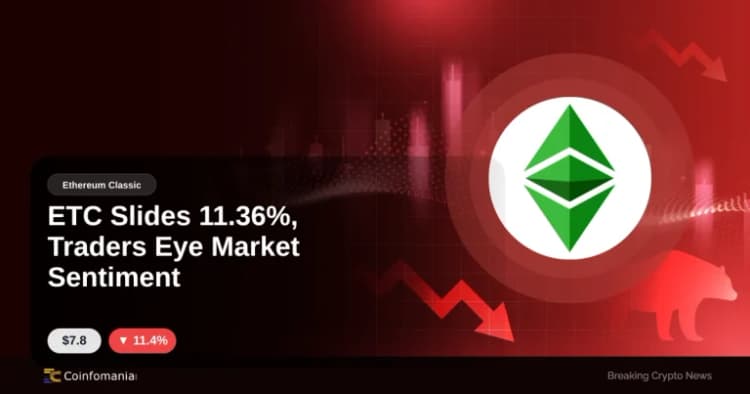
ETC Slides 11.36%, Traders Eye Market Sentiment
Ethereum Classic has faced a sharp decline of 11.36% in just one hour, raising concerns about market sentiment and future price movements.

Mikaeel
Author

Ethereum Classic to Implement Thanos Upgrade On November 29

Lele Jima
Author

Anonymous Hacker Returned $100,000 Worth of ETC Following 51% Attack

Wilfred Michael
Author

Ethereum Classic (ETC) Suffers 3693-Block Reorg Following Another 51% Attack
Wilfred Michael
Author
Ethereum Classic Welcomes OpenETC Client After OpenEthereum and MultiGeth Kickout

Ruth Shadrac
Author