A Practical Guide to Verifying Crypto Game Results Beyond the Fairness Badge
Learn how provably fair verification works by checking seed commitments, resolvers, paytables, and test vectors to independently verify game results.
- A seed commitment is the starting point of verification, not the complete proof.
- The correct resolver and paytable must reproduce the visible result and payout.
- Coin Flip and Limbo show why simple-looking games can still require different checks.
Provably fair technology is often summarized in one sentence: a player can verify that an online game result was not manipulated. The summary is useful, but it leaves out the practical question. What should a user actually check?
A complete verification follows a chain from the seed commitment to the final payout. If one part of that chain remains hidden, a green check mark may say less than it appears to say.
Step 1: Confirm the Original Commitment
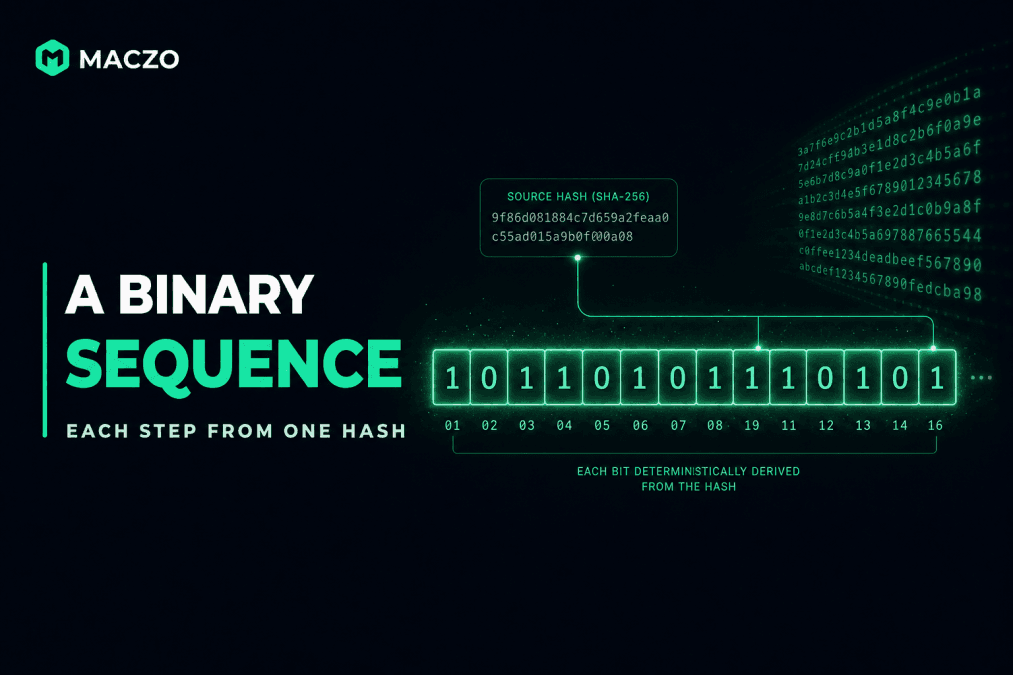
Before play, a platform can publish the SHA-256 hash of a secret server seed. The hash acts as a commitment because the server seed cannot be changed later without producing a different hash.
Once the relevant server seed is revealed for a settled result, the player hashes it again. A match confirms that the revealed value corresponds to the earlier commitment. It does not yet reproduce the game outcome.
Step 2: Recreate the Deterministic Input Stream
Provably fair systems commonly combine the server seed with a client seed and nonce through HMAC-SHA256. The client seed gives the player-visible input to the process, while the nonce separates one round from the next.
Some provably fair implementations also use a cursor when a game requires additional words from the digest stream. The same server seed, client seed, nonce and cursor should generate the same 32-bit values in both the platform’s verifier and an independent implementation.
Step 3: Use the Resolver for the Correct Game
The deterministic stream still needs to be converted into a game result. A resolver performs that mapping. This is why a verifier for one title should not be treated as proof for a different title.
Coin Flip: Reproducing a Sequence of Heads and Tails
A Coin Flip resolver can reduce each 32-bit value modulo two and map the result to heads or tails. In a parlay mode, every flip must match the selected side. In a streak mode, the sequence ends at the first incorrect guess.
The payout grows according to the number of successful flips and the configured RTP. Verification therefore needs to reproduce the sequence, identify the first mismatch if one occurred and apply the same multiplier rule.
Limbo: Comparing a Result With a Target
Limbo transforms a 32-bit value into an E8 fixed-point multiplier using a formula based on RTP. The result is clamped within documented limits. A bet wins when the reproduced multiplier reaches or exceeds the player’s selected target.
Unlike Coin Flip, Limbo does not build a sequence of binary outcomes. It derives one multiplier and compares it with a target. Both games use the same shared cryptographic engine, but their resolvers answer different questions.
Step 4: Check the Published Paytable
A matching game outcome is not the end of the process. The paytable connects that result to the amount returned. It may contain RTP settings, fixed-point multiplier values or category-specific payouts.
For Maczo-developed Originals, the public repositories include game-specific paytables and test vectors. The Maczo Provably Fair help section provides the user-facing route into this documentation, while Maczo’s public GitHub organization exposes the implementation for technical inspection.
Step 5: Run Known-Answer Tests
Test vectors pair fixed inputs with expected outputs. They help confirm that a public verifier follows the documented recipe and has not drifted after an update.
A developer can run the JavaScript self-tests and compare the results with vectors produced by the authoritative server-side implementation. A non-technical user can rely on the browser tool, but the open tests make the result independently challengeable.
Questions a Player Can Ask
Before accepting a provably fair claim, users can look for a short list of evidence:
- Was a server-seed commitment available before the result?
- Is the revealed seed available for the settled round?
- Can the client seed, nonce and game parameters be identified?
- Is the game-specific resolver public or clearly documented?
- Are the paytable and known-answer tests available?
A platform does not need every player to read code. It does need to make the evidence available so that users, developers and independent reviewers can reach the same answer.
Why Scope Matters
Open verification should be described precisely. On platforms that publish source code for selected games, verification applies only to those documented implementations. The same claim should not automatically be extended to proprietary games supplied by external studios.
Regional positioning should also remain separate from the proof. A platform’s target market does not affect the verification process, which is based on deterministic inputs and reproducible code rather than geographic positioning.
What Provably Fair Does Not Guarantee
Provably fair technology does not remove the house edge, predict future outcomes or guarantee a winning session. It does not replace licensing, payment security, account protection, local law or responsible-play measures.
What it can prove is narrower: the revealed seed matches the earlier commitment, and the public inputs reproduce the settled result under the documented resolver and paytable.
Final Takeaway
The strongest fairness check is not a badge. It is a repeatable process. Coin Flip and Limbo demonstrate that even compact games need different mappings from cryptographic data to outcome.
When commitments, inputs, resolvers, paytables and tests are all available, users can move from accepting a platform’s conclusion to examining the evidence behind it.


Follow us on Google News
Get the latest crypto insights and updates.
Related Posts
How to Play Roulette Games With Crypto: Rules, Wallets, Bets and Safe Play Guideimage

Coinfomania News Room
Author

Bridging Two Worlds: How ZEN.COM Streamlines Digital and Traditional Capital Flows
Coinfomania News Room
Author

Crypto Casinos in Belgium: How They Work, and What the Law Says In 2026
Coinfomania News Room
Author