News · Latest News
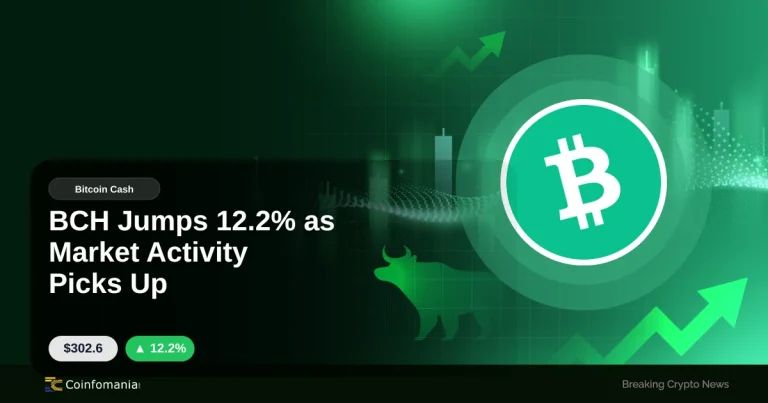
BCH Jumps 12.2% as Market Activity Picks Up
Bitcoin Cash has surged 12.2% in the last hour, now trading at $302.6. This rise reflects growing market interest and trading activity.
· 2 Min
Bitcoin Cash was launched as a new version of Bitcoin in August 2017 to solve Bitcoin's transaction speed and fee problems. Considering they have Bitcoin Cash rules, block size increased to 8MB and be further extended to 32MB, that leads to faster and cheaper payments to the users. Whereas it has a total supply similar to the Bitcoin’s, its fixed cap preserves a sense of scarcity. Transactions are much quicker with Bitcoin Cash, making it more suitable for merchants and users. Given that it has a decentralized system that is free from central control, it permits participants worldwide to use it and to innovate in simple, global payments.
Bitcoin Cash runs on a distributed ledger system through proof-of-work mining to validate agreed transactions by solving complex cryptographic challenges. The network supports up to 32MB blocks, which process many more transactions than Bitcoin's 4MB blocks at cheaper than one cent fees. All transactions become public view and stay protected without relying on third parties. Bitcoin Cash Node and other operating systems allow users to send BCH across the world consistently for both payment and money transfer services.
People regularly assess Bitcoin Cash based on its similarities to Bitcoin Ethereum and Litecoin. BCH functions as a Bitcoin version with the same SHA-256 algorithm and proof-of-work methods that concentrate on handling transactions faster and more inexpensively. While Bitcoin serves mostly as an investment vehicle, BCH intends to function as a currency for regular business transactions. Since Ethereum supports smart contracts, BCH offers faster yet restricted processing abilities. Litecoin works just as fast at low rates but holds less market influence. BCH's bigger transaction blocks make it better at handling more data but create possible centralization issues that no other cryptos experience.
|
Cryptocurrency |
Block Size |
Transaction Speed |
Primary Use Case |
|
Bitcoin Cash |
Up to 32MB |
Fast |
Digital Cash |
|
Bitcoin |
4MB |
Slower |
Store of Value |
|
Ethereum |
Variable |
Moderate |
Smart Contracts |
|
Litecoin |
4MB |
Fast |
Payments |
Bitcoin Cash makes use of robust blockchain technology and most importantly, a major focus is made on scalability. With block size of 32MB, it can have more transactions per block, hence lowering congestion and fees. It is secured and decentralised by leveraging proof-of-work and SHA-256 hash function. It has 21 million coins total in circulation, which prevents inflation. This supports token protocol for digital assets in its ecosystem. Today, the Bitcoin Cash project is maintained by multiple independent teams of developers who coordinate through Bitcoin Cash Research, and the independent nature of the nodes means that services like Bitcoin Cash Node and Bitcoin Unlimited can never be turned off.
As Bitcoin Cash enables fast and cheap blockchain transactions, it makes for an interesting investment case for those who want to be exposed to this limitation of Bitcoin. Because of its bigger block size and emphasis on scalability, it is suited for everyday payments and merchant adoption. It is a decentralized and a peer to peer digital cash system, while it maintains the principle of Bitcoin it aspires to be more usable. Nonetheless, Bitcoin Cash bears the risk of strong competition from other cryptocurrencies, and there is significant volatility risk along with its presence in a regulatory environment that could hurt Bitcoin Cash's prospects. Investing must be conducted only after careful research and professional advice.
By 2025, Bitcoin Cash is working in the environment of a dynamic regulatory framework. In the US, discussions between CFTC and the SEC, which continue in determining crypto overseers, could go down favoring lighter regulations in favour of the Trump administration. In global regulations, the focus is on the prevention of money laundering and frauds, which has increased KYC demands. Retail crypto access is limited in Australia by their ASIC and only Bitcoin and Ether are allowed in ETPs. In the U.S. digital asset tax reporting starts in 2026. Like BCH, classified as a commodity, the users must stay informed.
Bitcoin Cash can be purchased from the following:
BCH wallets include:
Software Wallets: Bitcoin.com Wallet, a self-custodial app, offers convenience and security for beginners.
Ledger and Trezor offer offline storage, which is best for long-term security. Self-custody, must use 2FA and updating often are some key security features. The wallets should balance usability with protection, so users should give preference to such wallets.
To secure BCH:
Bitcoin Cash is adopted for:
BCH’s future hinges on adoption, regulation, and innovation. It is scalable and has low fees and is therefore ideal for payments, especially in underserved areas. Its growth is however challenged by competition, regulatory hurdles and centralization risks. While continued development and merchant adoption may cement BCH’s role as digital cash, investors should keep watch over market and policy developments.
|
Pros |
Cons |
|
Faster transactions with larger blocks |
High volatility risks significant losses |
|
Low fees, ideal for microtransactions |
Larger blocks may increase centralization |
|
Scalable for high transaction volumes |
Competition from other cryptocurrencies |
|
Strong community and development |
Regulatory uncertainties impact value |
|
Practical for everyday payments |
Perceived as less secure than Bitcoin |
Based on the Bitcoin Cash vision to be peer-to-peer electronic cash, they offer fast and inexpensive transactions on their blockchain. It has a strong potential for growth through its adoption for payments and remittances and a robust ecosystem. However, optimism should be cautiously optimistic, given this volatility, regulatory uncertainties and competition. Secure storage and informed decision-making are all crucial to users. BCH’s future as an investment depends on market acceptance and regulatory clarity, which can be high risk and high reward in the current cryptocurrency market.
People can send and receive Bitcoin Cash digital money through a shared system that split away from Bitcoin in August 2017. Developers set up Bitcoin Cash as a new network to fix Bitcoin's speed problems by making blocks expand from 1MB to 8MB and then 32MB. BCH makes everyday payments possible thanks to its fast and affordable processing speed, even though people mostly treat Bitcoin as a saving tool.
Bitcoin Cash handles more transactions per block better than Bitcoin because its blocks can reach up to 32MB compared to 4MB max size (with SegWit). The network supports a greater number of transactions while charging minimal fees to users. Bitcoin mainly guards security, whereas Bitcoin Cash is built to speed up payment transactions in daily purchases and money transfers.
BCH operates on a secure proof-of-work blockchain network like Bitcoin. Despite the security benefits of BCH, users must take steps like storing their tokens safely and locking crypto with 2FA to shield their money from risks to cryptocurrency investments.
People use Bitcoin Cash mainly for digital person-to-person transactions and worldwide money transfers because they get their payments quickly without high costs. Some merchants within the Caribbean area and worldwide now embrace Bitcoin Cash payments along with their DeFi and token generation services. People use Bitcoin Cash to contribute to online groups by giving monetary rewards.
Buy BCH coins via each type of payment method on the three biggest exchanges (Binance, Coinbase and Kraken). You can acquire BCH using Bitcoin.com Wallet, plus peer-to-peer platforms LocalBitcoins. Always make sure to check the contract details and choose secure platforms when trading Bitcoin Cash after setting up strong wallet protection.
People use the Bitcoin.com Wallet for both mobile and web access, plus they choose Ledger, Trezor and Electrum Cash for their storage options. Bitcoin wallet choices exist at different security levels for both beginner and advanced users. You should use hardware wallets for secure long-term storage, while software wallets let you handle Bitcoin Cash conveniently each day.
Bitcoin Cash provides an acceptable crypto solution when people need low-cost transactions and fast scaling. Its investment value improves when more users start using it, especially in developing nations. The platform carries several challenges because market competition remains intense, while market values shift frequently, and rules keep changing. You should make your investment choices only after reading all necessary details and evaluating your personal risk exposure.
Bitcoin Cash supports small payments at costs of below $0.01, making it suitable for making payments and transferring money across borders. BCH's big block size makes it possible to keep fees this low. The process of conducting Bitcoin and Ethereum transactions becomes expensive at peak hours when they reach multiple-dollar fees.
Each region sets its own rules and standards regarding Bitcoin Cash, so it exists without central authority. In 2025, both the EU and US governments are working to create guidelines on cryptocurrency usage that include user identity verification and tax reporting. In most regions, BCH functions like a commodity, but users should monitor developing legal guidelines.
Users can create smart contracts and tokens using BCH through the SLP platform and connect to many DeFi platforms. Since BCH serves basic financial use better than complex decentralized applications, it lacks the same advanced tools that Ethereum offers on its platform.
Bitcoin Cash has surged 12.2% in the last hour, now trading at $302.6. This rise reflects growing market interest and trading activity.
· 2 Min