South Carolina Bans CBDC and Protects Bitcoin With Zero Tax Law

South Carolina Governor signed S.163 into law, banning CBDCs and protecting Bitcoin mining, self-custody, and crypto payment tax neutrality.

Quick Take
Summary is AI generated, newsroom reviewed.
Governor Henry McMaster signed bill S.163 after a near-unanimous 110-1 vote in the House.
The law implements a total ban on state agencies testing or accepting federal central bank digital currencies.
Tax neutrality protections prevent any extra fees or levies on goods purchased using digital assets.
Mining facilities and node operators are shielded from discriminatory ordinances and money transmitter licensing.
South Carolina just drew a clear line in the sand on digital finance. Governor Henry McMaster signed S.163 into law on May 19, 2026. This makes South Carolina one of the most crypto-friendly states in the U.S. The law bans state agencies from accepting or testing central bank digital currencies and protects self-custody rights. It establishes tax neutrality for crypto payments and shields miners, stakers, and node operators from discriminatory regulation.
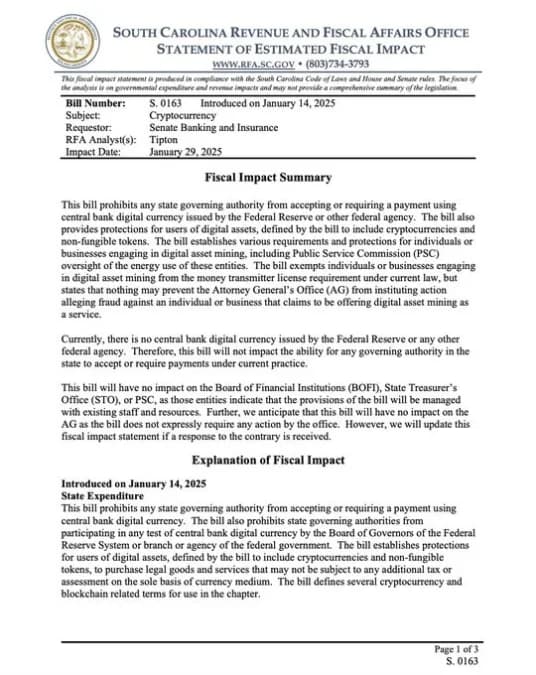
Official Fiscal Impact Statement Source: South Carolina Revenue and Fiscal Affairs Office
The bill passed the House 110-1. A vote that reflects genuine bipartisan conviction rather than political posturing. South Carolina news today positions the state as a serious contender for blockchain business relocation and crypto innovation investment.
Inside S.163: What the Law Actually Does
The legislation covers five distinct areas. Each one addresses a real friction point for crypto users and businesses operating in the state.
- First, the CBDC ban is absolute. State governing authorities cannot accept, require, or participate in any testing of central bank digital currency issued by the Federal Reserve or any federal agency. This creates an explicit state-level firewall against federal CBDC implementation.
- Second, tax neutrality protects crypto payments. Digital assets used to purchase legal goods and services cannot face any additional tax or assessment solely because of the payment medium. Bitcoin spends like dollars under South Carolina law.
- Third, self-custody rights are explicitly protected. Residents can use hardware wallets or self-hosted wallets without restriction or regulatory interference.
- Fourth, mining and node operations gain meaningful protections. Digital asset mining businesses cannot face restrictions that do not apply equally to other businesses in the same area, including noise ordinances. Miners operating in residentially zoned areas retain the right to operate while complying with local ordinances. Money transmitter license requirements are waived for mining, node operation, staking services, and crypto-to-crypto exchanges that do not involve legal tender.
- Fifth, energy accountability is built in. Mining businesses must demonstrate to the Public Service Commission. That they can reduce power consumption during grid stress periods. It’s a responsible safeguard that addresses the most common criticism of proof-of-work operations.
Reading the Broader Trend
South Carolina joins a growing list of states. That includes Texas and Florida, which have enacted anti-CBDC legislation. Bitcoin news updates from the state level increasingly tell the same story. States are moving faster than Washington on digital asset clarity. The timing is notable. The GENIUS Act just passed federally, establishing stablecoin reserve requirements. The Clarity Act is advancing through the Senate. South Carolina’s law complements federal momentum while addressing the privacy and sovereignty concerns that federal legislation leaves to states.
A Foundation for Crypto Business Growth
For miners, developers, and crypto companies evaluating relocation, S.163 removes three major barriers simultaneously. These include regulatory uncertainty, tax discrimination, and licensing complexity. South Carolina is now one of a small number of states. Where Bitcoin mining, self-custody, and crypto payments all operate within a clearly defined, protective legal framework. The 110-1 House vote is the most telling detail of all. When a crypto bill passes with that margin. It is not a political statement; it is a business decision.
References


Follow us on Google News
Get the latest crypto insights and updates.