Ripple Targets US-Mexico Remittances With MXNB on XRP Ledger

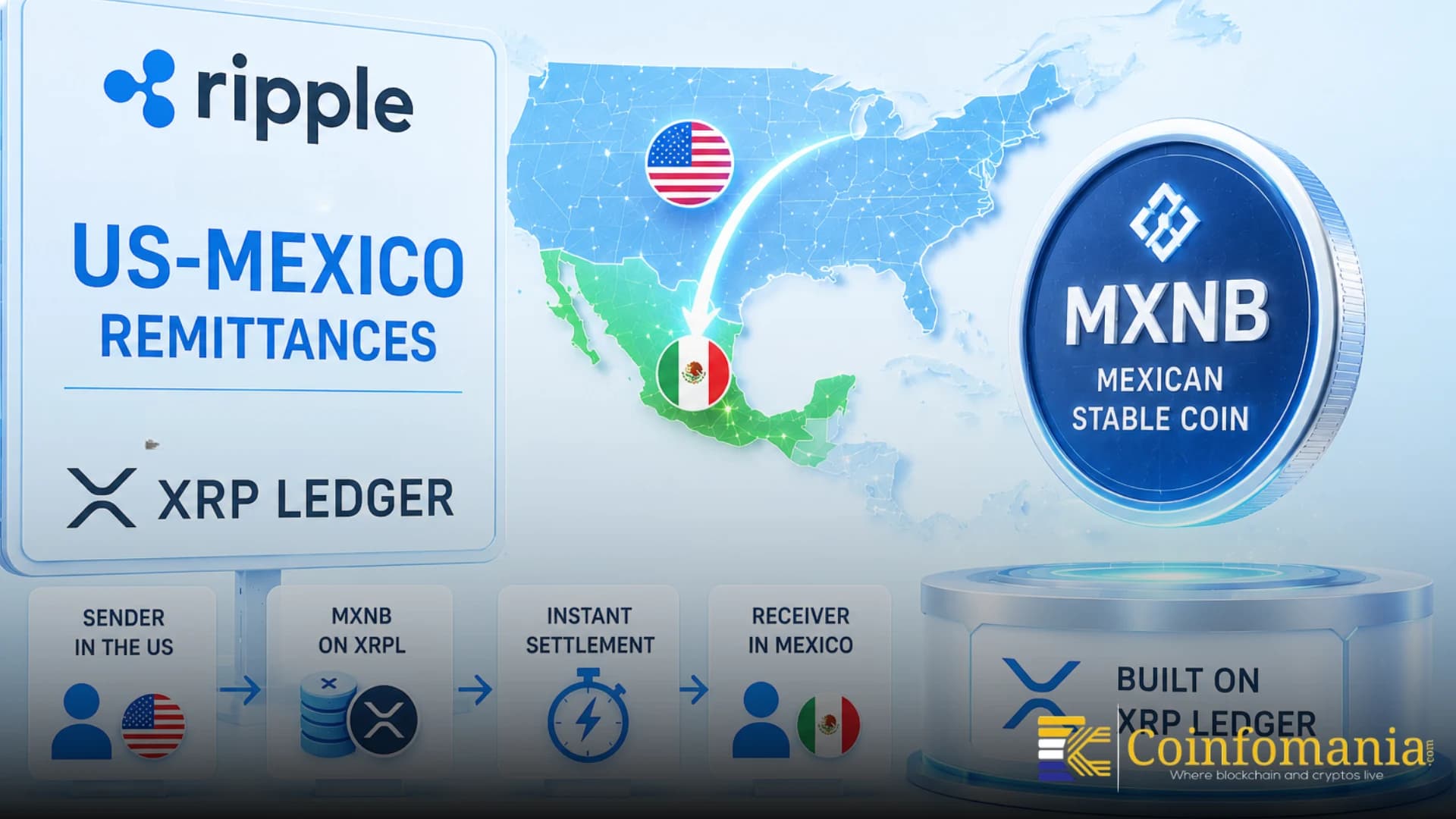
Ripple expands its partnership with Bitso to issue the MXNB Mexican peso stablecoin natively on the XRP Ledger for institutional settlements.
Quick Take
Summary is AI generated, newsroom reviewed.
The integration deploys the peso-pegged token alongside Ripple’s upcoming RLUSD stablecoin to anchor the high-volume U.S.-Mexico payment corridor.
MXNB will route directly through the XRPL Permissioned DEX to provide certified financial institutions with compliant, on-chain liquidity pools.
The structure eliminates traditional intermediary banking friction by allowing cross-currency transactions to settle peer-to-peer in seconds.
Spot market prices for XRP hovered near $1.14 following the announcement, reflecting a steady 3.8% performance curve over the weekly timeframe.
The race to modernize cross-border payments just took another major step forward. Ripple has expanded its long running partnership with Bitso to bring MXNB. It is a regulated Mexican peso-backed stablecoin onto the XRP Ledger. The move could reshape how money moves between the United States and Mexico. It’s one of the world’s largest remittance corridors. That enabls near instant settlements between dollar and peso-backed digital assets.
The latest development also strengthens Ripple’s push into real-world financial infrastructure. By combining RLUSD and MXNB on a regulated on-chain marketplace. The company is building tools designed for banks, payment providers and large enterprises rather than retail speculation.
Ripple and Bitso Expand Their Partnership
The Ripple Bitso partnership expansion builds on years of collaboration across Latin America. Under the new arrangement, Bitso’s regulated stablecoin MXNB will be issued on the XRP Ledger and integrated into Ripple’s Payments on DEX infrastructure. The stablecoin will operate alongside RLUSD, Ripple’s U.S. dollar-backed stablecoin.
Together, the two assets will provide regulated dollar and peso liquidity for enterprise payment flows across the U.S. Mexico corridor. Ripple and Bitso have already supported payment infrastructure across several Latin American markets. However, this new integration moves the partnership beyond payments and into on-chain settlement infrastructure.
What Makes the Permissioned DEX Different?
Unlike traditional decentralized exchanges, XRPL’s Permissioned DEX is designed specifically for regulated financial institutions. Only verified and approved participants can access the platform’s liquidity pools. At the same time, users still benefit from blockchain based settlement speeds and transparency.
This approach allows institutions to access on-chain liquidity without sacrificing compliance requirements. According to Ripple, businesses will be able to settle transactions between RLUSD and MXNB directly on-chain in seconds. Rather than relying on multiple intermediaries and correspondent banks.
Why the US-Mexico Corridor Matters
The U.S. Mexico payment corridor processes tens of billions of dollars every year. Traditional cross-border transfers often involve several financial institutions, multiple settlement layers and added costs. These processes can take days to complete. The new infrastructure aims to reduce those inefficiencies.
“By bringing together RLUSD and MXNB on the XRPL Permissioned DEX, we’re helping create regulated, on-chain liquidity infrastructure purpose-built for enterprise cross-border payments,” said Silvio Pegado, Ripple’s Managing Director of LATAM. Bitso also emphasized the importance of regulated peso liquidity for institutional payment providers operating across the region.
What This Means for XRP and Enterprise Adoption
While the announcement is focused on stablecoins. It could indirectly strengthen the long term utility of XRP and the broader XRP Ledger ecosystem. The launch demonstrates how blockchain infrastructure is increasingly being used for real financial operations rather than purely speculative trading. More enterprise activity on XRPL may attract additional institutions seeking faster settlement and lower operational costs.
For developers, the expansion creates new opportunities to build payment and liquidity solutions on top of XRPL’s growing infrastructure. For investors, the development highlights Ripple‘s continued strategy of targeting real-world financial use cases. As regulated assets and payment flows move onto blockchain networks, many market participants see this as a key driver of long-term adoption.
XRP Price Holds Steady
At the time of writing, XRP price was trading around $1.14, up roughly 3.8% over the past week. Although the market reaction has remained relatively muted. The announcement adds another piece to Ripple’s broader enterprise payments strategy. As adoption grows across Latin America, the XRP news may prove more significant for long-term utility than short-term price action.
References


Follow us on Google News
Get the latest crypto insights and updates.