Bhutan Denies $1B Bitcoin Selloff — But Arkham Data Says Otherwise

Bhutan’s sovereign fund DHI denies selling Bitcoin, but Arkham data shows national reserves dropped from 13,000 BTC to 3,121 BTC.

Quick Take
Summary is AI generated, newsroom reviewed.
CEO Ujjwal Deep Dahal denied selling BTC, despite Arkham tracking $230 million in 2026 outflows.
National reserves dropped roughly 76% from a 2024 peak of 13,000 BTC down to 3,121 BTC.
Recent activity includes a May 12 transfer of 100.44 BTC ($8.2 million) to an unlabeled address.
The drawdown leaves Bhutan short of its 10,000 BTC pledge for the Gelephu Mindfulness City project.
A $1 billion discrepancy is sitting between what Bhutan’s sovereign wealth fund says and what blockchain data shows. Arkham Intelligence has tracked over $1 billion in Bitcoin outflows from wallets attributed to Druk Holding and Investments. It’s Bhutan’s state investment arm since July 2025, flowing to exchanges and trading firms. DHI CEO Ujjwal Deep Dahal’s response to CoinDesk was brief and striking. “I don’t recall the last time we sold any BTC.” Bitcoin news today has a small Himalayan kingdom at its center, and the numbers do not add up cleanly on either side.
What the On-Chain Data Shows
Arkham’s wallet attribution for DHI has been active for years without prior dispute from the Bhutanese government. The data tells a consistent story. Holdings in Arkham-tagged Bhutan wallets have dropped from approximately 13,000 BTC in October 2024 to around 3,100 BTC currently. It’s a reduction of roughly 76% in under two years. Outflows have accelerated through 2026, with approximately $207 million leaving this year alone to various exchanges and trading firms. This includes wallets previously used to interact with Galaxy Digital and OKX.
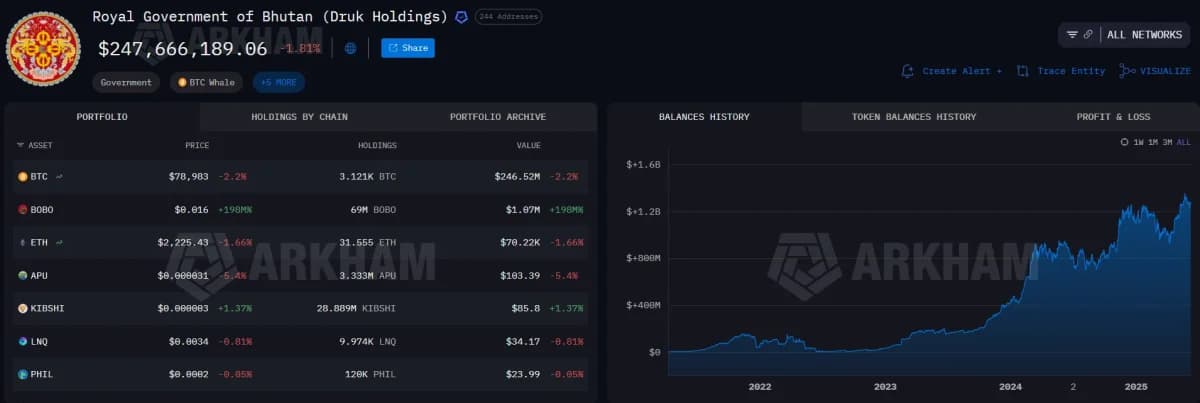
Bhutan currently holds 3,121 BTC ($246.5M). Source: Arkham Intelligence
At the current pace, Arkham projects Bhutan will have liquidated its remaining position entirely by October 2026. An Arkham analyst explained the logic of the on-chain movements directly. “When an entity sends assets to an exchange or an OTC trading firm, typically the purpose of the transfer is to exchange those assets. Depositing assets to exchanges generally indicates selling activity.”
What Bhutan Actually Says
DHI’s denial is categorical but narrow. When pressed specifically about the wallet movements tracked by Arkham. The fund responded only that “our statement stands and nothing to add beyond it.” The fund did not dispute Arkham’s wallet attribution. It did not confirm current holdings. It did not address the specific destination wallets.
DHI CEO Dahal separately stated that mining operations remain active. “Rain keeps our hydropower plants running at strong capacity and our mining operations active. All Bitcoin mined in Bhutan is powered by green energy, and we are continuously upgrading to the latest-generation rigs to remain competitive.”
However, it reported in March that no significant inflows to Bhutan’s known wallets have occurred in over a year. It is an unusual gap for an active mining operation.
The Gelephu Pledge Problem
The most concrete consequence of the apparent drawdown involves Bhutan’s December 2025 Bitcoin Development Pledge. With a commitment of up to 10,000 BTC toward the development of Gelephu Mindfulness City, a new economic zone. At current holdings of approximately 3,100 BTC, Bhutan does not have enough Bitcoin remaining to honor that pledge at face value. The kingdom still holds an unrealized profit of roughly $754 million on its remaining position. But the math on the Gelephu commitment no longer works.
What This Means for Investors
For Bitcoin mining news followers and sovereign Bitcoin watchers, Bhutan’s situation highlights a structural tension in state-held Bitcoin positions. Governments that mine and hold Bitcoin face the same liquidity management pressures as any treasury. While on-chain movements ultimately tell a story that official statements cannot fully contradict.
A source close to one of the trading firms that received Bitcoin from Bhutan-tracked wallets confirmed no sales have taken place recently. It leaves open the possibility that transfers represent custody arrangements, collateral posting, or OTC structures rather than spot sales. That ambiguity may explain DHI’s technically accurate but narrowly framed denial. The blockchain does not forget. But it does not always reveal the full picture either.


Follow us on Google News
Get the latest crypto insights and updates.