News · Últimas Notícias
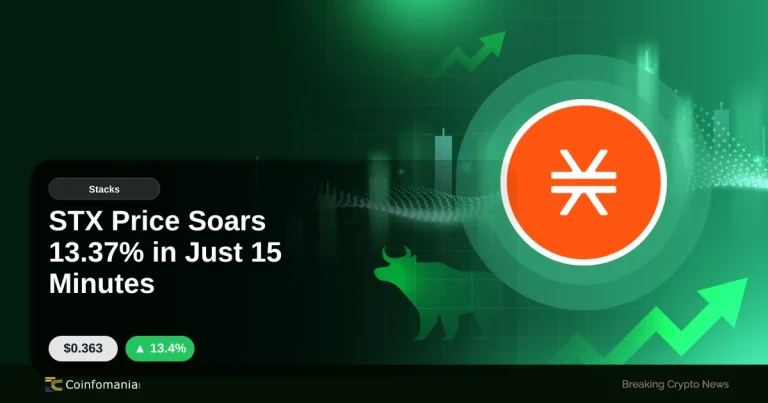
STX Price Soars 13.37% in Just 15 Minutes
STX has surged 13.37% in the last 15 minutes, reaching $0.363 as trading picks up.
· 2 Min
Stacks (STX) is the latest Layer 2 (L2) blockchain to offer the full power of Bitcoin. This allows smart contracts, decentralized applications (dApps) and DeFi without changing the Bitcoin base layer. Stacks, launched in 2021, settles transactions on Bitcoin’s blockchain, using Bitcoin’s much higher security coupled with programmability. Clarity is its native smart contract language that focuses on predictability and security, whereas Proof-of-Transfer (PoX) consensus makes network participants get rewarded in Bitcoin. As such, Stacks is essential infrastructure as it bridges Bitcoin’s $1+ trillion market cap with decentralized innovation that enables Bitcoin (Layer 1) to transition into a programmable, multi-functional ecosystem (Stacks, Layer 2).
As a Bitcoin L2, Stacks performs computations off chain and secures final settlement on Bitcoin’s blockchain. The Stacks architecture contains a number of key components.
Bitcoin trusts the network of Stacks as the base layer, and smart contract functionality is provided without the need to change Bitcoin itself.
Stacks occupies a unique niche compared to other blockchains and L2s:
By focusing exclusively on enhancing Bitcoin, Stacks appeals to both Bitcoin maximalists and Web3 developers.
Human-readable and decidable, Clarity smart contracts eliminate many common blockchain vulnerabilities by making outcomes predictable. Every transaction links to a Bitcoin transaction ID, ensuring transparency and verifiability.
Rather than consuming energy, miners “transfer” Bitcoin to earn STX rewards. STX holders can “stack” tokens to secure the network and earn Bitcoin rewards, creating a circular Bitcoin economy.
sBTC will introduce a decentralized, 1:1 Bitcoin peg on Stacks, enabling Bitcoin-native DeFi without custodians. This innovation is poised to drive significant growth.
Stacks’ tech stack is built for maximum Bitcoin alignment, developer safety, and decentralized finance innovation.
Pros:
Cons:
Stacks offers an attractive opportunity for Bitcoin believers but remains a high-risk, high-reward investment.
By 2025, regulatory landscapes are maturing for Bitcoin L2s:
Stacks’ anchoring to Bitcoin’s regulatory status (viewed largely as a commodity) may offer some protection compared to purely altcoin-based projects.
Earn BTC with STX: Move your STX into wallets like Hiro or Xverse and participate in stacking to earn Bitcoin rewards.
Security Best Practices:
Stacks’ ecosystem continues to grow:
Over 50+ dApps and 1M+ monthly transactions highlight steady network growth.
Challenges include scaling microblocks efficiently and maintaining decentralization at scale, but Stacks' positioning looks strong for future growth.
In other words, this is a bold vision: to change Bitcoin from a passive store of value to a vibrant smart contract and dApp ecosystem. It stands out from competitors in its technical innovations, focus towards developers, and Bitcoin synergy. Despite major regulatory headwinds and formidable competition, Stacks is positioned well for the long term, given its distinct gateway to a Bitcoin decentralized future.
Stacks is a Bitcoin Layer 2 blockchain that makes it possible to build smart contracts, DeFi, NFTs, and dApps without changing a thing on Bitcoin’s base layer. Bitcoin’s capabilities are being extended by anchoring all its transactions to the Bitcoin blockchain via a special consensus mechanism called Proof of Transfer (PoX). It allows Bitcoin to be programmable while keeping its security.
Stacks processes transactions off-chain and then settles them to Bitcoin’s blockchain periodically ~every 10 minutes by anchoring its blocks to Bitcoin blocks. The reason this connection exists is to make sure that the hash power security of Bitcoin is inherited by Stacks. Also, Stacks transactions are tied to a bitcoin transaction — this means the whole process is transparent and immutable.
Stacks' smart contract language is Clarity, which is a decidable language, that is one can predict how the code will execute before deployment. It’s readable by humans; that way, developers do not need to worry about bugs similar to the reentrancy attack or the infinite loop that’s common on Ethereum's Solidity. The focus on safety fits Bitcoin’s ’conservative’ character.
Stalks use PoX as the consensus mechanism. Similarly, instead of expending energy to mine Bitcoin, miners accept STX to provide them the eligibility to mine STX blocks. In exchange, STX tokens are distributed, and the STX holders who participate in ‘stacking’ can earn steady bitcoin rewards. This leads to a cyclical economy between the native chain Bitcoin and Stacks.
Staking sBTC (in 2024) is a 1:1 Bitcoin-pegged decentralized asset on Stacks. Unlike standard WBTC models, sBTC tries to be fully trustless and secured by smart contracts. This enables Bitcoin-native DeFi use cases such as lending, borrowing and yield farming, all fully backed by Bitcoin.
You earn Bitcoin rewards by helping secure the network by “stacking” your STX tokens (not staking). To enter pools, STX holders lock their tokens with a period that varies using supported wallets such as Hiro or Xverse. In return, miners place bids in PoX rounds in order to receive BTC payouts—historically earning miners 5–10% APY.
In 2023, the U.S. SEC announced that STX is a security that can change STX’s listing properties on U.S. exchanges and also its trading. However, outside the U.S., viewing Bitcoin L2s more positively, such as the EU (under MiCA), may happen if they resolve to recognize Bitcoin’s commodity status.
The most popular wallets for STX include:
Lightning Network optimizes for Bitcoin payments and small micropayments, whereas Stacks does for DeFi, NFTs, and DAOs and makes these things possible. For one, Lightning is used for speed, while Stacks for programmability. They both seek to scale Bitcoin, but through different processes.
Stacks supports a growing ecosystem of real-world use cases:
STX has surged 13.37% in the last 15 minutes, reaching $0.363 as trading picks up.
· 2 Min