News · Últimas Notícias
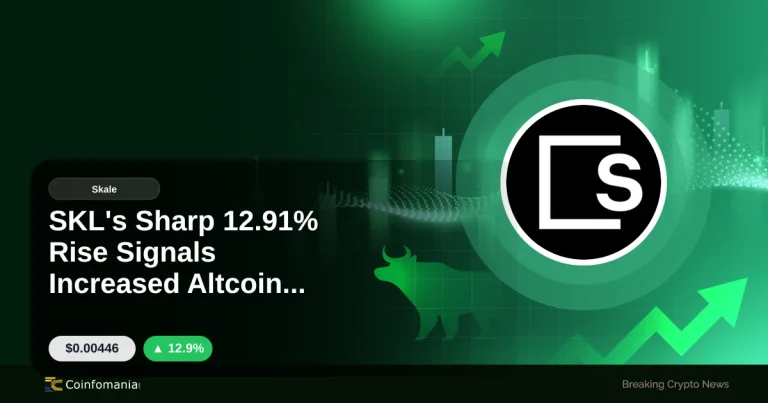
SKL’s Sharp 12.91% Rise Signals Increased Altcoin Activity
SKL surged 12.91% in just 30 minutes, indicating strong momentum in the altcoin market. Traders should monitor support and resistance levels closely.
· 2 Min
The SKALE Network is an Ethereum-native multichain platform that is solving Ethereum’s persistent scalability problem. SKALE was founded in 2018 by Jack O’Holleran and Stan Kladko to allow developers to easily spin up customisable, zero gas fee (0gfe) sidechains running on a decentralized network called Elastic Sidechains. They are interoperable with Ethereum, and these sidechains are optimised for use cases including gaming, DeFi, NFTs and AI.
Unlike other altcoins that exist as their own layer 1 chains, SKALE lives and breathes on the Ethereum chain. It works as a layer 2 scaling solution and also provides the flexibility and independence of sidechains. SKALE is gas-free for users since developers pay for the chain subscriptions with SKL tokens. This significantly improves the user experience by removing friction all the way down at the dApp level.
With SKALE’s multichain architecture, horizontal scaling takes place, where new nodes provide additional network capacity. There are more than 100 chains on the network that together average more than 39,000 TPS. Each chain chews through roughly 2,000+ transactions per second (TPS). They also facilitate instant on-chain file storage in addition to EVM (Ethereum Virtual Machine) compatibility with Ethereum tools.
Elastic Sidechains are customizable blockchains that are created and managed by the developers on SKALE. These sidechains run on a hybrid PoS consensus system and are coordinated by the SKALE Manager, a collection of more than 35 smart contracts deployed on Ethereum.
They stake SKL to run nodes and earn rewards or, if you do not want to run nodes, you can stake SKL with validators who will then participate in network rewards. The SKALE pools security model employs a number of validators across chains to achieve the maximum possible level of decentralization and resilience. It also helps protect against Miner Extractable Value (MEV) and chain reorganisations.
SKALE’s zero-gas model has attracted projects across multiple verticals:
As of 2025, the network hosts over 100 dApps and facilitates 100 million+ weekly transactions.
The SKALE token (SKL) serves multiple purposes:
SKALE uses a monthly reward distribution system with no unbonding period, though tokens remain locked for the chosen staking duration. This structure promotes consistent participation and reduces token volatility.
As of May 2025, SKL trades around $0.02069 with a market cap of $120.2 million, down 96% from its all-time high of $1.22. Forecasts for 2025 vary:
Despite volatility, SKALE’s ability to save users over $10 billion in gas fees positions it as a valuable component of the Ethereum ecosystem.
SKALE operates under the N.O.D.E. Foundation in Liechtenstein and SKALE Labs in the U.S. It launched through ConsenSys Codefi’s Activate platform to ensure regulatory compliance. While SKL’s classification by the SEC remains uncertain, Europe’s MiCA regulations and pro-crypto jurisdictions like Liechtenstein and Singapore provide a stable foundation.
SKL is an ERC-777 token, compatible with:
To secure holdings:
The platform stands out thanks to its scalability, not requiring gas fees and supportive architecture for developers. Nevertheless, challenges arise with decreasing demand for L2 solutions, intense competition posed by alternative projects such as Arbitrum and Optimism, as well as regulatory uncertainty.
The SKALE platform allows developers to deploy high performance, gas free sidechains that are customized to their dApps using SKALE.
Yes, but it differs from typical rollups by offering Elastic Sidechains, which operate independently while still connecting to Ethereum for security.
Instead of users paying gas, developers cover subscription costs using SKL tokens, allowing end-users to transact without fees.
Each sidechain is capable of processing operations in the rate of 2,000+ TPS, and with network growth, SKALE is able to reach hundreds of thousands of TPS.
Yes. It uses a hybrid Proof-of-Stake consensus and a pooled validator model to ensure decentralization and resistance to attacks.
Absolutely. Users can stake SKL either by operating validator nodes or by delegating to existing validators to earn rewards.
Binance, Coinbase, KuCoin, Gemini, and Uniswap provide SKL. So, to be able to store your tokens, you will need a crypto wallet.
Ethereum wallets that are compatible with SKL are Metamask, Coinbase Wallet, Ledger, Trezor and Rainbow.
From gaming, to decentralized finance, NFTs, AI/ML, to sports engagement apps, SKALE supports a wide range of sectors.
Price volatility, regulatory uncertainty, and stiff competition from other ETH scaling solutions are problems that SKALE has to deal with.
SKL surged 12.91% in just 30 minutes, indicating strong momentum in the altcoin market. Traders should monitor support and resistance levels closely.
· 2 Min