News · Últimas Notícias
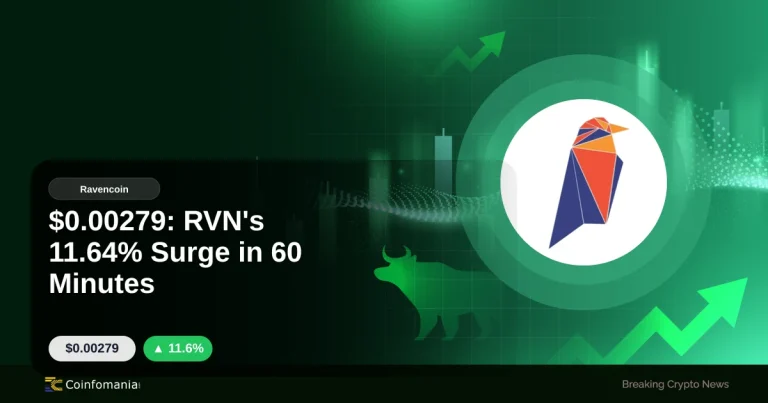
$0.00279: RVN’s 11.64% Surge in 60 Minutes
RVN has surged 11.64% in just 60 minutes, now priced at $0.00279. This rapid increase highlights shifting market dynamics.
· 2 Min
The blockchain behind Ravencoin (RVN) is devoted to helping people send both digital and real assets directly to one another. Launched three years ago, it works by allowing users to create, issue and handle special tokens for owning real land and digital things like video game assets. Ravencoin is different from Bitcoin or Ethereum, as it only deals with asset tokenization and transfer to guarantee decentralization and resistance against censorship. Since RVN does not have an ICO, pre-mine or is managed by a central group, it holds tightly to the principles of open development by the community.
Ravencoin is a fork of Bitcoin, sharing its UTXO model and proof-of-work (PoW) consensus mechanism, but with key modifications. It uses the KawPow hashing algorithm—optimized to resist ASIC dominance and keep mining decentralized.
Here’s how it differs from Bitcoin:
Once created, these tokens can be sent across the Ravencoin network instantly and globally, enabling decentralized trading of tokenized securities, collectibles, licenses, and more.
|
Feature |
Bitcoin |
Ethereum |
Ravencoin |
|
Purpose |
Digital money |
Smart contracts |
Asset issuance |
|
Consensus |
PoW (SHA-256) |
PoS (from Merge) |
PoW (KawPow) |
|
Supply |
21 million |
Unlimited |
21 billion |
|
Asset capabilities |
Not native |
Strong (ERC-20) |
Native |
|
Dev team |
Anonymous/Satoshi |
Vitalik + Foundation |
Community-led |
Ravencoin’s singular mission to tokenize assets gives it an advantage in that niche. While Ethereum offers similar features through smart contracts, Ravencoin’s simpler, built-in token protocol avoids contract-level complexity and exploits.
Even though its foundation is the Bitcoin code, Ravencoin is made for the efficient handling of digital assets. The network uses KawPoW which is intended to block ASIC mining and support participation from numerous people with GPUs. This leads to fairer mining methods and cuts down risks of centralization. Unlike with Ethereum, where assets have to be issued using smart contracts, Ravencoin treats them as in-built features, making issuing and managing assets easier, quicker and more secure.
The platform allows assets to be given specific names, has places for sub-assets and manages restricted assets for adding extra compliance. The system also offers messaging and polling features so issuers can talk with holders and facilitate token-based votes. Ravencoin further connects with IPFS (InterPlanetary File System), allowing for secure, unchanging storage of information on NFTs, licenses and ownership records. For that reason, Ravencoin is an efficient and reliable blockchain that supports decentralized asset tokenization.
As of May 2025, Ravencoin (RVN) trades at $0.01239, with a circulating supply of over 15 billion coins. While it's up around 58% year-over-year, it remains down over 95% from its all-time high of $0.2852 in 2021. The token continues to attract interest for its focused utility in asset tokenization and fair mining model.
Despite its unique use case, Ravencoin’s relatively small market cap of under $200 million means investors should expect significant price swings. Its niche appeal and grassroots development offer long-term potential, but also come with the higher volatility typical of mid- to low-cap crypto assets.
Ravencoin operates in a gray regulatory area, especially concerning tokenized real-world assets. While the protocol is neutral, how individuals use it can fall under securities regulations, depending on jurisdictions.
In the U.S., for instance, tokenizing equity or debt on Ravencoin could trigger SEC compliance requirements. However, the Ravencoin network itself—like Bitcoin—is decentralized and non-custodial, making direct regulation challenging.
As tokenization frameworks mature globally (e.g., Europe’s MiCA), Ravencoin may need ecosystem partners to offer compliance layers.
RVN is widely available on centralized exchanges (CEXs) including:
To buy:
Users can store RVN on both hot and cold wallets:
As with all crypto assets:
Being a PoW coin, Ravencoin’s network security comes from mining power. As of now, it remains robust, with active community miners and resistance to ASIC centralization via KawPow.
While not mainstream yet, Ravencoin has found traction in several niches:
Its lightweight architecture appeals to developers seeking token creation without complex contract coding.
Ravencoin's growth hinges on:
Despite low media attention today, Ravencoin’s fundamentals remain strong for its narrow but valuable use case.
Ravencoin isn’t trying to be everything for everyone. It’s not competing with Ethereum on DApps or with Solana on throughput. Its mission is less-focused: create, manage, and transfer assets with security and simplicity. For crypto purists, developers, or asset issuers seeking a no-frills platform, Ravencoin is a strong contender. But investors should temper expectations—it’s a slow-burner, not a moonshot. For those who believe the future is tokenized, RVN offers a solid foundation, minus the hype.
Token types called restricted assets can be moved between wallets that are on the permission list. It matters a lot for following the law, particularly for businesses with ties to securities or sensitive sectors with KYC/AML rules.
Yes. Real estate, company stocks and gold certificates can be officially represented using Ravencoin tokens. Attaching metadata and legal paperwork to IPFS means anyone can verify the legitimacy and ownership of a work.
Every tag is a label used to mark what an asset can or cannot do. As an example, a tag could designate a given address as “accredited” or “non-US” to follow legal rules for transfers of regulated assets.
You can easily create assets in KnownOrigins by burning 500 RVN and issuing the tokens. Issuers are able to get in contact with token holders and change the supply based on the type of token.
Yes. With the use of unique data and IPFS metadata, Ravencoin users are able to manage and create NFTs right on the Ravencoin blockchain, rather than using the smart contract standards from Ethereum.
Not with the approach they are traditionally used to. Ravencoin does not support running advanced smart contracts using a virtual machine. Still, its main purpose is to manage simple and secure asset transfers by applying established rules.
In order to have a unique asset, users need to burn 500 RVN. To post sub-assets, you must use 100 RVN and each message costs only 5 RVN, so the network is protected from spam at a low price.
People work together to develop Ravencoin which has no official foundation or main authority. GitHub and Discord are where the IBC community votes and discusses what to decide and upgrade.
Users can add and handle Ravencoin with their computers using Ravencoin Core, get a mobile wallet with Trust Wallet or consider using ZelCore. All the asset management features are available in Ravencoin Core right from the desktop.
Right now, users cannot use Ravencoin bridges or wrapped tokens to operate between different blockchains. It is not a general programming tool, but a chain specifically made for assisting in asset tokenization.
RVN has surged 11.64% in just 60 minutes, now priced at $0.00279. This rapid increase highlights shifting market dynamics.
· 2 Min