News · Últimas Notícias
Whales Make Waves — QTUM Surges 24% in Just 30 Minutes
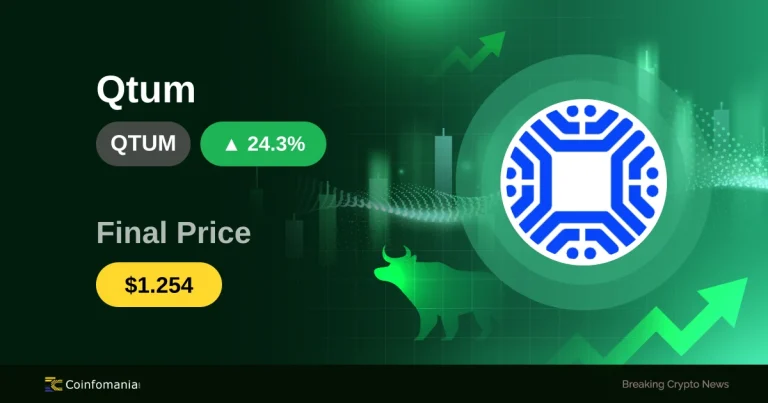
QTUM has experienced a remarkable price surge of 24.28%, reaching $1.254 as whale accumulation drives market interest.
· 2 Min
Qtum is a hybrid blockchain platform that was made available in 2017. It uses Bitcoin’s design for UTXO transactions and includes Ethereum’s smart contract development environment through the Ethereum Virtual Machine. PoS enables Qtum to deliver scalable and decentralized dApps and enterprise applications. Been created to provide a secure, efficient and flexible blockchain environment for programmers, enterprises and organizations.
Qtum employs a PoS process to reach a transaction agreement. Validators are chosen according to the amount of QTUM they've staked and the length of time they’ve controlled those tokens. It dramatically lowers power consumption and increases transaction throughput.
With AAL, Qtum enables smart contracts to operate on Ethereum’s EVM using Bitcoin’s transaction model. The integration helps programmers build Ethereum dApps in a context they can trust.
Qtum combines Bitcoin’s solidity with Ethereum’s efficiency in one blockchain. Qtum has always relied on proof-of-stake—while Ethereum implemented the technique much later. It provides Qtum with efficiency in energy use and has the potential for long-term scalability.
Qtum stands in the same space as projects such as Cardano, Polkadot and Solana all committed to supporting smart contracts and scalability. Leveraging capabilities of both Bitcoin and Ethereum allows Qtum to successfully run dApps with high-grade security.
Qtum utilizes Bitcoin Core because of its reputation for strength and trustworthiness. Mergers with the EVM let developers deploy smart contracts easily and access Solidity development. Account Abstraction Layer enables the use of smart contracts in an environment with both UTXO and account models.
Qtum’s Decentralized Governance Protocol let its block parameters and gas prices change without requiring a hard fork. Qtum benefits from this by being able to upgrade itself in the future.
Partway through 2025, Qtum’s price stands at $2.39, with a market cap of about $252 million. Analysts expect prices ranging from $3.75 to $4.47 by December 2025, but any increase will ultimately depend on how popular the currency becomes.
Qtum’s efficiency, compatibility with the world’s second-largest blockchain and its suitability for enterprise uses promise a prosperous future. Of course, similar to any cryptocurrency, the price of Qtum may fluctuate widely due to market conditions and governmental regulations.
Qtum and all cryptocurrencies are kept subject to increasingly stringent guidelines. Many top exchanges will ask users to undergo KYC and AML processes as part of their registration in 2025.
A wide range of governments around the world are now implementing more transparent cryptocurrency regulations. The rules make a difference to how Qtum can be bought, sold and used in various regions. It’s important for developers and users to understand how blockchain projects but be subject to regulation.
Qtum is available for purchase and trade at several well-known exchanges including:
To purchase Qtum:
It’s recommended to transfer newly bought Qtum to a personal wallet immediately.
You can store Qtum using:
Protecting significant holdings is best done with a hardware wallet.
To protect your Qtum:
These steps lower the chances of losing or having your assets stolen.
Qtum is made to serve consumers as well as businesses. Common use cases include:
The platform is equipped to meet growing needs across different markets worldwide.
Qtum’s future will be influenced by further growth and collaboration. Its ability to work with Ethereum technology, together with its Bitcoin-style blockchain, makes it a competitive platform in today’s multi-chain environment.
Enhancing the network’s throughput and expansion in finance and logistics could lead to increased development. Qtum’s future may be enhanced by the continuous involvement of developers and changes in regulations.
Pros:
Cons:
With Qtum, customers have access to a complete set of resources needed to construct solid, adaptable decentralized applications and new ideas on a fusion of Bitcoin and Ethereum’s blockchains.
Qtum integrates the most secure Bitcoin payment capabilities with Ethereum’s top smart contract services through the introduction of Proof-of-Stake consensus.
The PoS consensus mechanism in Qtum actually reduces power consumption compared to Bitcoin’s PoW protocol.
Yes. Qtum allows developers to create ethical and notable smart contracts that work well with Ethereum’s EVM and existing Ethereum DApps.
You can buy Qtum right now for $2.39.
QTUM can be bought on any of these popular platforms Binance, Kraken, Coinbase and Gate.io.
Qtum’s proprietary Qtum Core wallets can be installed on your desktop computer while Trust Wallet supports usage from your smartphone. Your Qtum chain can also be stored in Ledger hardware wallets – Exodus wallets enable you to control all your crypto assets securely in one spot.
Yes. Qtum is built with the aim of helping businesses create trusted smart contracts and unlock bigger value within their proprietary blockchains.
AAL lets Qtum merge the UTXO paradigm with Ethereum’s account nature as well as grasp the capability to run smart contract applications building on Ethereum’s EVM.
Qtum relies on Proof-of-Stake and carefully maintains its decentralized governance. Its value changes just like for any other cryptocurrency.
QTUM has experienced a remarkable price surge of 24.28%, reaching $1.254 as whale accumulation drives market interest.
· 2 Min