News · Últimas Notícias
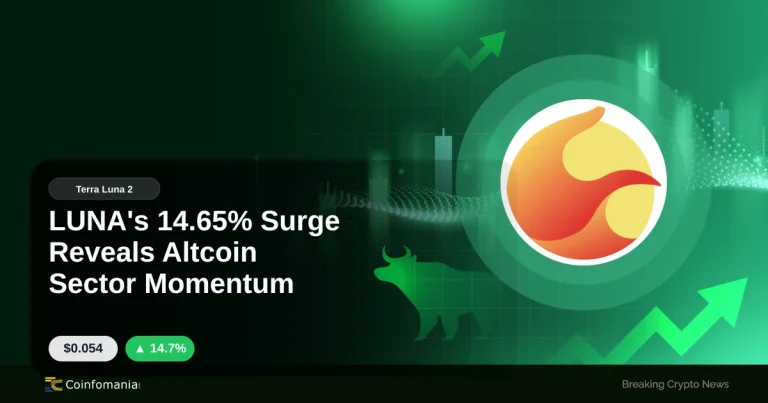
LUNA’s 14.65% Surge Reveals Altcoin Sector Momentum
LUNA recently surged by 14.65% in just one hour, reflecting renewed interest in the altcoin sector.
· 2 Min
Terra started in 2018 as an ambitious blockchain project creating algorithmic stablecoins. Its UST stablecoin and LUNA token worked together automatically - until May 2022 when everything crashed spectacularly. The collapse wiped out $40 billion, shaking crypto markets worldwide.
After the disaster, Terra was relaunched as Terra 2.0 with a simpler design. While some loyal supporters remain hopeful, many investors still feel burned. Founder Do Kwon now faces legal troubles while trying to rebuild. Today's Terra focuses on practical DeFi tools, but regaining trust after such a dramatic failure remains its biggest challenge.
Leveraging the native Token LUNA, various decentralized applications are facilitated on the proof-of-stake blockchain, Terra. Its primary goal remains focused on programmable payments along with the provision of DeFi services. Using Systems governance, staking, and other participatory actions in the ecosystem can enable users to partake actively in the governance framework.
Among the various kinds of cryptocurrencies, Terra holds a distinguished place. On one hand, Bitcoin is digital cash. Ethereum runs smart contracts. Terra specializes in algorithmic stablecoins for payments, blending crypto and traditional finance.
Most stablecoins (like USDT) use cash reserves. Terra balances its stablecoins with LUNA tokens algorithmically. In 2022, UST collapsed, causing Terra to fail and rebuild. Since then, Terra has focused on improving its Layer 1 blockchain for general DeFi use.
Unlike newer chains like Avalanche or Solana, Terra uses Cosmos SDK and Tendermint consensus. This gives it similar speed and cross-chain features. However, the trust deficit post-UST collapse remains a hurdle.
This makes Terra a strong choice for DeFi, payments, and cross-chain projects.
As of mid-2025, LUNA trades near $0.17. Various forecasts suggest it could reach $ 0.60 or stay around $0.21 by year-end. Investors must weigh Terra's history, legal risks, and crypto's unpredictable nature before buying.
Terra could appeal to risk-tolerant investors betting on a comeback. But smart investors should stay cautious, spread their investments, and keep an eye on legal and tech updates.
Terra's 2022 crash still affects its legal situation today. In 2025, Terraform Labs is bankrupt. Founder Do Kwon faces fraud charges in the U.S. and South Korea. After Terra's crash, regulators made strict new stablecoin rules. These rules make Terra's comeback difficult.
The ongoing legal battles continue to overshadow any technical progress, making Terra's recovery an uphill battle in the current regulatory climate.
LUNA is compatible with various wallets, including:
Terra's technology supports DeFi apps through smart contracts, but regaining trust after its collapse remains tough. While it has potential, the platform must prove its reliability to attract users and developers again. Success depends on delivering stability alongside innovation.
Terra's recovery depends on winning back trust and proving its technology works. While some analysts see price growth potential, the project faces tough hurdles—regulatory scrutiny, rebuilding its community, and attracting developers.
Terra’s comeback won’t be easy, but with the right steps, it could regain traction in crypto markets. Investors should stay cautious and watch for real progress.
|
Aspect |
Pros |
Cons |
|
Technology |
High throughput and smart contract support |
Past vulnerabilities and security concerns |
|
Investment |
Potential for growth if the ecosystem recovers |
High volatility and regulatory risks |
|
Adoption |
Focus on DeFi applications |
Reduced user trust post-2022 collapse |
|
Regulation |
Efforts to comply with legal requirements |
Ongoing legal proceedings and regulatory scrutiny |
Terra's story has been a rollercoaster of breakthroughs, explosive growth, and painful crashes. Now in 2025, the project is working hard to fix its past mistakes and earn back its spot in the competitive DeFi world. While there may be opportunities ahead, smart investors know to keep their eyes open - watching closely as Terra tries to rebuild trust and prove it can deliver real value again.
Terra is a blockchain that specializes in stablecoins and DeFi apps. It uses LUNA to stabilize its dollar-pegged cryptocurrencies. After its 2022 crash, it rebranded with a new chain.
Terra’s stablecoins maintain their peg through a balancing system. When demand drops, LUNA gets burned to reduce supply. When demand rises, new LUNA is minted to stabilize the price. This mechanism aims to keep stablecoins like USTC close to $1.
After the 2022 crash, Terra shifted toward partial reserves instead of pure algorithms. While improvements exist, users remain cautious due to past failures. Full trust recovery may take time.
Some platforms still accept Terra-based stablecoins for transactions, though adoption has declined. DeFi apps like Astroport enable swaps and payments, but options are fewer than before.
LUNA is the new token on Terra 2.0, launched after the reboot. LUNC belongs to the original chain (now called Luna Classic). They operate on separate blockchains.
Exchanges like Binance, KuCoin, and Kraken support LUNA trading. Users should verify liquidity and security before purchasing.
Terra continues pushing DeFi and stablecoin solutions, though rivals like Ethereum dominate the space. Its future hinges on winning back trust from both developers and everyday users. Without wider adoption, growth may remain limited compared to stronger blockchains.
Most activity revolves around DeFi—lending, staking, and trading. A few NFT projects still use Terra, but adoption is slower than before.
Staking LUNA still provides rewards, though not as high as before the crash. How much users earn depends on how many people are using the network. The performance of validators also plays a key role in determining staking returns.
UST lost its dollar peg due to flawed algorithm design and panic selling. The resulting crash wiped out LUNA’s value, leading to Terra’s eventual reboot.
LUNA recently surged by 14.65% in just one hour, reflecting renewed interest in the altcoin sector.
· 2 Min