News · Últimas Notícias
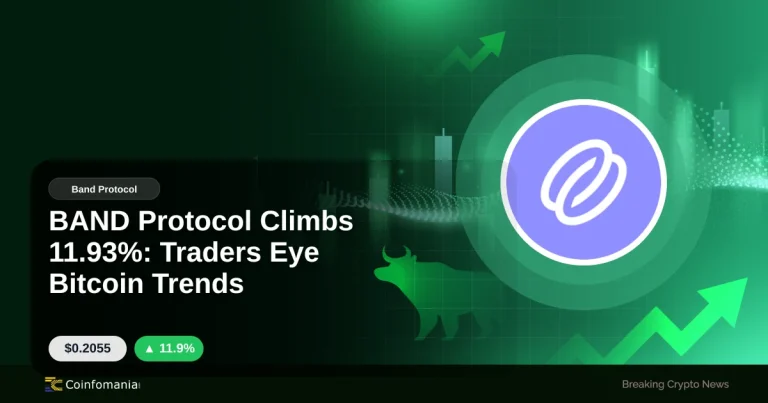
BAND Protocol Climbs 11.93%: Traders Eye Bitcoin Trends
BAND Protocol's price surged 11.93% in just five minutes, reaching $0.2055 amid shifting market dynamics.
· 2 Min
Band Protocol started in 2019 when Soravis, Paul, and Sorawit built a tool to bring real-world data to blockchains. Today, it tracks prices for 175+ cryptos and 20+ currencies/commodities, feeding this information to apps on Ethereum, Cosmos, and Solana. This system helps DeFi platforms and other blockchain projects get the accurate data they need to work properly.By providing verified price feeds, sports results and custom data requests, Band has become essential infrastructure for DeFi platforms, prediction markets and NFT projects that need trustworthy external inputs. The system's cross-chain compatibility and growing list of supported data types position it as a key player in blockchain's evolution toward real-world utility.
Band Protocol connects real-world data to blockchains through a decentralized oracle network.
|
Feature |
Band Protocol (BAND) |
Typical Cryptocurrencies (e.g., Bitcoin, Ethereum) |
Oracle Competitors (e.g., Chainlink) |
|
Purpose |
Provides real-world data to blockchains (oracle) |
Digital money/store of value (BTC) or smart contracts (ETH) |
Same oracle role, but different tech |
|
How It Works |
Validators verify data feeds for dApps |
Blockchain transactions/mining |
Node operators fetch data for smart contracts |
|
Use Cases |
DeFi price feeds, sports results, weather data |
Payments, investments, NFTs |
Similar to Band, but with alternate designs |
|
Blockchains |
Works across Ethereum, Cosmos, Solana |
Usually native to one chain (e.g., ETH only) |
Often Ethereum-first (like Chainlink) |
|
Token Use |
Pays validators and secures the network |
Mainly for transactions/fees |
Also pays node operators for data |
Band Protocol runs on its custom blockchain called BandChain, which was developed using Cosmos SDK technology. This setup enables fast transactions and seamless connections between different blockchains. The system relies on a staking model where token holders help validate transactions, balancing security with performance.
In 2025, the team launched testnet upgrades for their Oracle system, focusing on two key improvements: faster data delivery and clearer verification processes for users. These changes aim to strengthen the network's reliability as more applications adopt its services.
Band Protocol presents a compelling case for investors interested in blockchain infrastructure. As a leading oracle solution, it supports 200+ price feeds and processes over 1 million daily data requests for major DeFi platforms like Venus and Alpha Finance. The token’s utility in securing the network (through staking) and paying for data services creates real demand, while its cross-chain compatibility with Ethereum, Cosmos, and Solana positions it well for multi-chain growth.
However, competition from Chainlink and regulatory uncertainty about oracle tokens pose risks. With a current market cap under $200 million, BAND could see upside if oracle demand grows, but remains a high-risk crypto asset. Investors should weigh its technical advantages against market volatility.
Band Protocol runs as a community-governed oracle network with no central ownership. While this decentralized structure reduces some legal risks, regulators in the EU and U.S. are still examining tokens like BAND under new crypto rules. The project maintains compliance by focusing on BAND's utility for data services rather than promoting it as an investment.
To acquire BAND tokens:
Storing BAND tokens securely is essential:
To protect your BAND tokens:
Band Protocol's oracle services are utilized in various sectors:
Band Protocol is expanding to meet the growing demand for reliable blockchain data. Its roadmap focuses on adding more support for networks (especially faster Layer 2 chains), attracting enterprise users, and upgrading the present technology. This will help provide secure data services for the decentralized world, expanding beyond Ethereum and Cosmos to newer platforms. Band is also working to onboard institutional data providers and improve its infrastructure for real-world asset tokenization.
Recent updates highlight plans to optimize gas costs and processing speeds, making the protocol more competitive against rivals like Chainlink. With the DeFi sector expected to grow, Band's scalable oracle solutions could see wider adoption if execution matches its roadmap. However, success depends on maintaining technological edge and navigating an increasingly crowded oracle market.
Band Protocol remains crucial for blockchain operations, delivering trustworthy data to smart contracts. BAND's regular improvements and industry partnerships indicate promising growth ahead.
The network's cross-chain compatibility and expanding data feeds strengthen its position in the oracle space. As blockchain adoption grows, Band's reliable infrastructure will likely play an increasingly important role.
Band Protocol is a decentralized oracle network that connects real-world data to blockchain smart contracts. It provides reliable price feeds, sports results, and other external data to DeFi applications. The BAND token powers the network and is used for staking and payments.
Band Protocol's system works in three simple steps. First, data providers send information to the network, which validators then check for accuracy using a staking system that rewards honest participation. Once verified, this trusted data gets delivered to smart contracts across different blockchains for use in automated agreements.
Band Protocol was founded by three founders - Soravis, Paul, and Sorawit in 2019. The founders have strong backgrounds in blockchain technology and data management systems. The project is now maintained by a decentralized community.
Band focuses on cross-chain compatibility (Ethereum, Cosmos, Solana) using IBC protocol. It offers faster and cheaper data feeds compared to some competitors. However, Chainlink has a larger market share and more integrations.
BAND’s value depends on oracle demand in DeFi and other blockchain applications. Its fixed supply (100M tokens) could support price growth if adoption increases. However, it faces competition and crypto market risks.
Band Protocol uses a decentralized network of validators who stake BAND tokens to verify data accuracy. Malicious validators risk losing their staked tokens through slashing penalties. The system also allows data proofs to be checked on-chain for transparency.
Band supports cryptocurrency price feeds, sports results, weather data, and custom API requests. Over 200 live data feeds are currently available. Developers can request new data types through governance proposals.
Band delivers most data within 3-6 seconds per request. Its Cosmos-based architecture enables faster finality than some Ethereum competitors. High-frequency data (like price feeds) updates every few seconds.
BAND secures the network through staking and pays for Oracle services. Validators earn rewards for processing data requests. Token holders can also vote on governance proposals.
Band Protocol's BAND token is currently priced at $0.7604. Over the last day, trading activity reached $12.22 million in volume. The project's total market value now stands at $122.53 million based on circulating supply.
BAND Protocol's price surged 11.93% in just five minutes, reaching $0.2055 amid shifting market dynamics.
· 2 Min